The International Conference entitled Women, Mining and Human Rights: Beyond the Challenge held in Guatemala from the 14 to 17 of March, 2010. The Conference brought together women activists and representatives from partner organisations throughout Latin America as well as experts in the field of human rights, gender mainstreaming, sustainable development and corporate social responsibility.
Conference Overview
The Conference, hosted by the Latin American Mining Monitoring Programme and the Union of Latin American Women (a regional network of women affected by mining), was the first public effort of rural and indigenous women human rights defenders affected by mining to raise awareness about the gender-based issues they face in their struggle to have their rights for self-determination, land and livelihood recognised by governments and corporations.
This ground-breaking international conference brought together for the first time women human rights defenders and representatives from ULAM partner organisations as well as experts in the field of human rights, gender mainstreaming, sustainable development and corporate social responsibility.
The Conference provided a unique forum for networking, information sharing and the discussion of key issues for women, activists and communities affected by mining policy and practice.
A key component of the Conference was a series of capacity building and training workshops aimed at identifying risks as well as reducing the vulnerability and increasing the capabilities of women human rights defenders to respond to the various challenges and dangers associated with their work.
The Objectives
The Conference considered current and emerging issues affecting women from mining-affected communities. As well as the challenges that women human rights defenders face in their struggle to have their voices and concerns heard by governments and corporate stakeholders. The Conference provided a forum for the exploration of the specific challenges faced by rural and indigenous women as defenders of environmental and human rights.The conference identified sources of internationational support and protection for urgen cases.The Conference represented a unique opportunity to hear first-hand presentations regarding the experiences of women affected by mining developments in Latin America.
The Conference:
1.Provided evidence of the links between conflict in mining affected communities and violence against women human rights defenders;
2.Highlighted the extent and impact of persecution on women activists as well as the specific safety issues they face;
3.Facilitated effective alliances with regional and international organisations and women human rights defenders;
4.Highlighted the range of corporate and state abuses experienced by mining affected communities throughout Latin America, which constitute serious obstacles to human rights activism.
The Conference was open to women activists; human rights defenders; academics/researchers working on mining issues from national, regional or global perspectives; NGOs and special interest groups.
Background
In Latin America, as in other regions of the developing world, mining is promoted as an economic activity with the potential to play a significant role in sustainable development and the fight against poverty. However, this position has failed take into account the specific concerns of women from mining-affected communities and address the impact of mining developments on rural and indigenous women.
Women are generally excluded from or less likely to benefit from compensation or economic opportunities associated with mining development. They are also more severely affected by and bear the greater burden of negative health, social and environmental impacts of the extractive industry. The environmental, social, cultural and economic changes brought about by mining developments are transforming women’s lives and demanding new roles for them. How can women influence these changes? How do women cope with the complex and competing demands of traditional livelihoods and the new economic and social realities brought by mining developments to isolated rural communities?
Contact us for more information on the conference
Despite the perception that mining does not have gender-specific impacts, rural and indigenous women are at the forefront of mining opposition. However their activism for environmental and social justice carries great personal risks. Rural and indigenous women activists are particularly vulnerable to intimidation and violence from pro-mining groups. Poverty and isolation from national and international support networks makes them easy targets for multiple forms of abuse. There is no doubt that in Latin America all human rights defenders face serious challenges, however anti-mining activists are particularly vulnerable and often face brutal represssion given the industry’s prominent role as a revenue source in the region. Concerned by the increase of violent conflict in mining-affected communities and efforts to silence those women activists that challenge such abuses, LAMMP has developed a regional database for monitoring and compiling evidence of human rights violations against women (the LAMBDA Project). Thanks to this innovative effort, for the first time the extent of the link between mining developments and the abuse of women’s human rights can be fully appreciated.
The Way Forward
In order to address these complex issues, the International Conference highlighted the impact of mining on women, identified the risks facing women environmental and human rights defenders, and explored the gap between corporate social responsibility policy and practice in the mining industry. In particular, the Conference locked into strategies to stimulate, support and sustain women’s efforts to become agents of change, capable of influencing mining policy and development.
The focus of the conference was:
-
The under-representation and complex barriers which prevent rural and indigenous women from effectively engaging and participating in community and mining decision-making processes;
-
The emergence of rural and indigenous women as environmental rights activists and the implications for democracy, equality and human rights activism in Latin America;
-
Women human rights defenders experiences of their efforts to reclaim their rights for self-determination, land and livelihoods;
-
The tensions and conflict surrounding the work of women activists as defenders of environmental, economic, social and cultural rights in mining-affected communities.
-
The security risks faced by women human rights defenders and identified risk management strategies and tools which can be used to address safety and protection issues.
For further information or media enquiries please contact us: [email protected]
“Women delegates during the press conference”
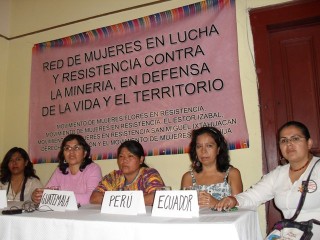
Click here http://www.vimeo.com/11735844 for the conference’s video which captures the conferences’ vibrancy and the range of issues discussed by delegates.
Sponsored by the Taiwan Fund for Democracy
[bfthumbs category=”design” numposts=”3″]